
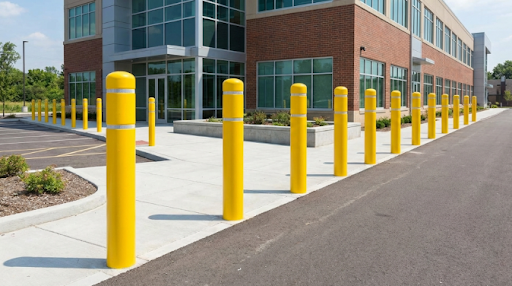
Traffic control and perimeter security rely heavily on strategically placed robust barriers to protect pedestrians and property. When planning a commercial or residential security layout, selecting the right bollard material determines both the installation’s functional strength and visual appeal. Property owners often consult with a professional bollards supplier in Cumming to evaluate which options best withstand local weather conditions while meeting specific safety requirements. This expert guidance ensures the final installation provides adequate resistance against vehicle impact while maintaining the site’s accessibility.
Understanding Common Bollard Materials
The market offers several material choices, each designed to address specific threats or architectural needs. Understanding the properties of these materials helps inform decisions for long-term site protection and durability.
Steel and Stainless Steel
Steel remains the industry standard for high-security applications due to its exceptional tensile strength and resistance to vehicular impact. Stainless steel offers these same protective qualities but adds a significant layer of corrosion resistance, making it ideal for storefronts or areas where visual presentation is as important as safety. These units are frequently filled with concrete after installation to maximize their stopping power against heavy vehicles, creating a formidable barrier that withstands significant force.
Concrete and Stone
For permanent installations where aesthetics need to blend seamlessly with landscaping or historical architecture, concrete or stone options provide a solid solution. These barriers rely on sheer mass and weight to stop traffic rather than structural flexibility. They often feature decorative elements that allow them to serve as architectural highlights rather than just functional security measures. While extremely durable against weather, they are typically fixed in place and do not offer the removability or flexibility that steel options might provide for changing access needs.
Polyurethane and Plastic
Not every situation requires heavy-duty impact resistance; sometimes, the goal is simply visual guidance. Flexible polyurethane bollards are designed to bend upon impact and return to their original shape, minimizing damage to vehicles while clearly marking lanes. These are excellent for parking lots and driveways where low-speed collisions are common, and the primary objective is organizing traffic flow rather than stopping a hostile vehicle.
Integrating Bollards into Wider Security Plans
Effective perimeter security rarely relies on a single type of barrier to do all the work. A comprehensive approach usually involves coordinating various elements to create a seamless, impenetrable boundary around a property.
Cohesive Perimeter Solutions
Bollards often serve as the first line of defense at entry points and storefronts, but they must work in harmony with other boundary definitions to be truly effective. A skilled fence manufacturer in Cumming can ensure that the spacing and style of vehicle barriers complement the surrounding enclosure systems for a unified appearance. This coordination is vital for maintaining high security standards without sacrificing the curb appeal of a commercial facility or residential estate, ensuring there are no weak points between the vehicle barriers and the perimeter fencing.
Customization and Professional Installation
Suppliers provide extensive customization options to ensure barriers fit the specific environment, including custom powder coating, reflective taping for night visibility, and various cap styles. Professional installers ensure these customized units are anchored securely into the substrate, whether concrete or asphalt. Proper installation is critical because even the strongest material will fail if the foundation is weak. Relying on experts guarantees that the bollards perform as intended during an impact event, protecting the assets behind them.
Conclusion
Selecting the appropriate material for traffic barriers involves balancing security needs, environmental conditions, and aesthetic preferences. Whether choosing the sleek look of stainless steel or the heavy-duty nature of concrete, the quality of the product significantly affects a location’s safety. Engaging with industry professionals ensures the chosen solution provides reliable protection and integrates well with existing site features, creating a secure environment.